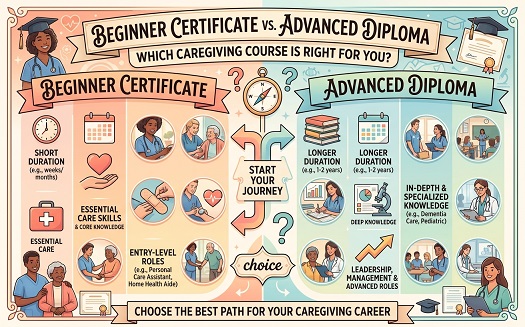
One of the first real decisions you'll face when starting a caregiving career isn't about finding a job — it's about choosing the right training. Search for "online caregiver certification course" and you'll quickly run into two very different-sounding options: a beginner certificate and an advanced diploma. Both promise to prepare you for work in caregiving, but they differ significantly in depth, time commitment, cost, and what they ultimately open up for you professionally.
Choosing between them isn't just a matter of "cheaper vs. more expensive" or "faster vs. slower." It's a decision that shapes which jobs you're competitive for, how quickly you start earning, and how far your certification carries you as your career develops. This guide breaks down exactly how a beginner certificate and an advanced diploma in caregiving differ, who each one is genuinely built for, and how to make the right call for your specific situation — so you can enrol with confidence in the course that actually fits your goals.
Why This Decision Matters More Than It Might Seem
It's tempting to think of this choice as simply "start small and upgrade later if needed." That instinct isn't wrong, exactly, but it can cause you to underestimate how much the right starting choice affects your first year in the profession. Consider what's actually at stake:
- Time to employment. A shorter course gets you into the job market faster, but only if it covers what employers in your target role actually expect to see.
- Starting pay and negotiating position. More comprehensive training tends to support stronger starting offers, particularly for specialised or private care roles.
- Confidence on the job. Caregiving involves real responsibility for vulnerable people from your very first shift — the depth of your training directly affects how prepared you feel handling unfamiliar situations.
- Long-term career trajectory. Some roles, particularly those involving dementia care, complex conditions, or supervisory responsibility, are simply harder to access without more comprehensive training behind you.
Getting this decision right the first time saves you money, time, and the frustration of feeling underprepared or, alternatively, having over-invested in training you didn't strictly need yet. Let's break down exactly what each option involves.
What Is a Beginner Certificate in Caregiving?
A Beginner Certificate in Caregiving is designed to get you from zero caregiving background to job-ready as efficiently as possible. It's built around the essentials: what every caregiver needs to know to start working safely, professionally, and confidently in an entry-level role.
Typical structure and content:
A well-built beginner certificate, such as the Certificate in Caregiving offered at MS Caregivers Academy, typically runs around 5 hours of structured content across a handful of core modules, covering:
- Understanding healthcare systems and how care work fits within them
- Professional standards and workplace conduct expected of caregivers
- Core communication skills for working with clients, families, and colleagues
- Legal and ethical fundamentals every caregiver must understand
- Essential day-to-day caregiving skills needed to work safely and competently
Who a beginner certificate is genuinely built for:
- People testing whether a caregiving career is the right fit before committing further time and money
- Those who need to start earning as quickly as possible
- Individuals with some informal caregiving background (such as family caregiving) who mainly need a formal credential to match their existing experience
- Anyone targeting general, entry-level home care or residential care roles rather than specialised or clinically involved positions
What a beginner certificate typically does NOT cover in depth:
- Dementia-specific care techniques and communication strategies
- Management of complex or chronic health conditions
- End-of-life and palliative care practices
- Advanced personal care protocols for clients with significant support needs
This isn't a criticism of beginner certificates — they're designed intentionally to be efficient and focused, not comprehensive. The question is simply whether that focus matches what you actually need right now.
What Is an Advanced Diploma in Caregiving?
An Advanced Diploma in Caregiving takes a significantly deeper approach, designed not just to get you hired, but to prepare you for the fuller range of situations caregivers encounter — including the more challenging, specialised scenarios that a beginner certificate doesn't have time to cover.
Typical structure and content:
A comprehensive diploma, such as the Diploma in Caregiving available through MS Caregivers Academy, typically runs around 26 hours across ten modules — roughly five times the depth of a beginner certificate — covering everything in the beginner curriculum plus:
- Dementia support: communication techniques, behaviour management, and daily care strategies for clients living with cognitive decline
- Management of common chronic health conditions caregivers regularly encounter
- Comprehensive personal care protocols: bathing, dressing, mobility, and maintaining dignity for clients with more significant support needs
- Safety procedures and infection control practices appropriate to more complex care environments
- End-of-life and palliative care: supporting clients and families with compassion and clinical awareness during life's final stages
Who an advanced diploma is genuinely built for:
- People who want to be competitive for higher-paying or specialised caregiving roles from their very first application
- Anyone planning to work with clients who have complex needs — dementia, chronic illness, or requiring end-of-life support
- Those aiming for senior carer, team leader, or supervisory positions sooner rather than years down the line
- Learners who may eventually want to work internationally and want training recognised as comprehensive across multiple markets
- Career changers who want to enter caregiving with strong, well-rounded competency rather than the bare minimum
The trade-offs of choosing a diploma:
- A longer time commitment before you're certified and able to start applying (typically four to eight weeks of part-time study versus one to two weeks for a beginner certificate)
- A higher upfront course cost, reflecting the substantially greater depth and number of modules
- More material to genuinely absorb, rather than simply pass through
For many learners, these trade-offs are well worth it — but they're real, and worth weighing honestly against your specific circumstances rather than assuming "more is always better."
Real-World Scenarios: Which Course Fits Which Situation
Sometimes it's easier to recognise the right choice by seeing it applied to a specific situation rather than working through abstract criteria. Here are several common scenarios and how the decision typically plays out in each.
Scenario one: The career changer with no care background, needing income soon. Someone leaving retail or hospitality work, with bills to pay and no prior caregiving exposure, typically benefits most from starting with the beginner certificate. It gets them into paid work fastest, and they can build toward a diploma once they've stabilised financially and confirmed the career fits them.
Scenario two: The experienced family caregiver formalising years of unpaid care. Someone who has spent several years caring for an aging parent, including navigating dementia symptoms, medication routines, and mobility challenges, often already possesses much of what a beginner certificate would teach. For this person, the diploma tends to represent significantly better value, since it extends and formalises knowledge they may already partially hold, while the certificate might feel redundant.
Scenario three: The recent graduate exploring caregiving as a first career. A young adult with no clear specialisation in mind, testing whether caregiving suits their interests and temperament before committing further, is well served by the beginner certificate. It's a lower-risk way to confirm fit before investing in more comprehensive training.
Scenario four: The caregiver specifically drawn to dementia or palliative care. Someone who already knows they want to work with clients experiencing cognitive decline or nearing end of life should strongly consider the diploma from the outset, since these are exactly the specialised areas a beginner certificate skips over, and starting with a course that doesn't address your actual target area risks wasted time.
Scenario five: The applicant facing a competitive local job market. In areas where care homes and agencies report receiving many applications per opening, a diploma-certified candidate typically stands out more clearly than one holding only a beginner certificate, simply because it demonstrates a more substantial, harder-to-dismiss level of preparation.
Scenario six: The learner planning an eventual move abroad. Someone who suspects they might relocate internationally within the next few years, even without firm plans, benefits from the diploma's more comprehensive scope, since internationally recognised, in-depth training tends to translate more smoothly across different countries' hiring expectations than a narrower beginner credential.
Thinking About Return on Investment, Not Just Sticker Price
It's worth reframing the certificate-versus-diploma decision away from "which costs less" and toward "which gets me a better return relative to what I put in," since the two courses aren't really competing on the same axis.
The beginner certificate's return on investment comes from speed and accessibility. For a modest cost and just one to two weeks of study, you gain the credential needed to start applying for entry-level roles almost immediately. Its value lies in how quickly it converts into paid work, not in how comprehensively it prepares you for every possible caregiving scenario.
The diploma's return on investment comes from depth and differentiation. The additional cost and study time typically pay for themselves through access to roles that pay more, involve more meaningful work, or simply exist in greater supply for candidates who can demonstrate readiness for complex needs. Caregivers who complete a full diploma often find they spend less time in the lowest-paying entry tier, since they qualify for better-compensated positions sooner.
A useful way to think about it: the beginner certificate optimises for time-to-first-paycheck, while the diploma optimises for the trajectory of your paycheck over the following one to two years. Neither goal is wrong — they simply serve different priorities, and the right choice depends on which one matters more to your current circumstances.
Side-by-Side: How the Two Courses Actually Compare
Rather than a table, here's a clear narrative comparison across the factors that matter most when making this decision.
On time commitment: the beginner certificate is built for speed, often completable within one to two weeks of consistent part-time study. The advanced diploma asks for a more substantial commitment, typically four to eight weeks, reflecting its far greater scope.
On depth of content: the beginner certificate covers the essential foundation every caregiver needs. The advanced diploma covers that same foundation and then extends significantly further into specialised, condition-specific, and complex-needs care that many employers actively look for beyond entry level.
On cost: the beginner certificate is priced as an accessible, low-barrier entry point into the profession. The advanced diploma costs more upfront, reflecting its substantially larger scope, but frequently pays for itself faster than expected once you factor in access to better-compensated roles.
On job readiness: both prepare you to work safely and professionally in caregiving. The beginner certificate positions you well for general entry-level roles. The diploma positions you for both entry-level roles and the more specialised, higher-responsibility positions that a basic certificate alone typically can't unlock.
On career trajectory: the beginner certificate is an excellent starting point that can always be built upon later. The advanced diploma front-loads much of that additional training, meaning your career progression toward specialised or senior roles can begin sooner, without needing to pause working life again for further study down the line.
On confidence and preparedness: caregivers who've completed a full diploma frequently report feeling more prepared for the unpredictable, emotionally complex situations that arise in real caregiving work — dementia behaviours, declining health, end-of-life conversations — simply because they've studied these scenarios directly rather than encountering them for the first time on the job.
Understanding Qualification Levels: Why "Certificate" and "Diploma" Aren't Just Marketing Terms
It's worth understanding that the distinction between a certificate and a diploma isn't arbitrary branding — it reflects genuine, recognised differences in depth and scope within how vocational training is generally structured and understood. According to the UK government's own explanation of what different qualification levels mean, qualifications are typically categorised not only by level of difficulty but also by size — essentially, the total study and assessment time a credential represents, with diplomas generally representing substantially more content and depth than certificates or awards at a comparable level.
This matters practically because employers reading your CV understand this distinction, even informally. A diploma signals a broader, more thorough course of study than a certificate — which is exactly why a comprehensive Diploma in Caregiving tends to carry more weight for specialised or senior-track roles than a beginner certificate alone, regardless of which specific awarding body issued either credential.
A Realistic Framework for Deciding Between the Two
Rather than guessing, work through these questions honestly to identify which course genuinely fits your situation:
Question 1: How quickly do you need to start earning? If you need income within the next few weeks and can't realistically commit to a longer study period first, a beginner certificate is the pragmatic choice — you can always build toward a diploma once you're working and earning.
Question 2: What kind of caregiving work do you actually want to do? If you're drawn specifically toward dementia care, complex needs support, or palliative care, a diploma is worth prioritising from the start, since these are precisely the areas a beginner certificate doesn't cover in depth.
Question 3: Do you already have relevant experience? If you've spent years as an informal family caregiver, you may already understand much of what a beginner certificate covers — in which case, a diploma might represent better value, since it formalises and extends knowledge you may partially already have, rather than repeating basics you've effectively already learned through experience.
Question 4: What's your realistic budget right now? Financial reality matters. If a diploma isn't currently affordable, a beginner certificate is a completely legitimate, respected starting point — not a lesser choice, simply an earlier stage in a longer-term plan.
Question 5: How competitive is your local job market? In areas with many caregiving applicants and few open roles, a diploma can meaningfully differentiate you from other beginner-certified candidates competing for the same entry-level positions.
Question 6: Are you planning to work internationally at some point? If international caregiving work is even a modest possibility for your future, a more comprehensive diploma from an internationally recognised provider tends to carry more weight across multiple countries' hiring markets than a narrower beginner certificate alone.
The "Start with a Certificate, Build to a Diploma" Strategy
For many learners, the smartest approach isn't choosing one course exclusively — it's sequencing both deliberately. This strategy works particularly well for people who need to start earning quickly but also want to build toward stronger long-term career prospects:
Phase one: Complete a beginner certificate in caregiving to enter the job market as quickly as possible, typically within one to two weeks.
Phase two: Gain several months of hands-on experience in an entry-level caregiving role, building practical skills and confidence alongside your formal training.
Phase three: Enrol in the full Diploma in Caregiving once you're established, using your growing real-world experience to deepen and contextualise the more advanced material — dementia care, complex conditions, end-of-life support — you're now studying.
Phase four: Use your combined certificate, diploma, and practical experience to move into specialised, senior, or higher-paying caregiving roles that were out of reach with entry-level training alone.
This phased approach lets you earn while you learn, avoids the risk of over-investing in training before you've confirmed caregiving is the right fit, and still ends with the same comprehensive credential profile as someone who started with the full diploma from day one — just spread more comfortably across your available time and budget.
When Skipping Straight to the Diploma Makes More Sense
That said, sequencing isn't always the better strategy. Going straight for the Diploma in Caregiving makes more sense if:
- You already have some caregiving background (formal or informal) and don't need the beginner-level content repeated
- You have a clear, specific goal — such as dementia care or palliative support — that the diploma addresses directly and the certificate doesn't
- You're not under immediate financial pressure to start earning within the next few weeks
- You want to avoid the administrative friction of completing two separate enrolments and simply prefer a single, comprehensive course of study
- Your target employer or market (particularly competitive urban job markets, or international opportunities) clearly rewards more comprehensive training from the outset
There's no universally "correct" answer here — both starting the smaller certificate and starting the full diploma are reasonable, common paths taken by successful caregivers, and continued professional development bodies like Skills for Care consistently emphasise that caregiving is a field built around ongoing learning rather than a single, one-time qualification — meaning whichever course you start with, it's genuinely a starting point rather than a final destination.
Common Misconceptions About Choosing Between the Two
"The diploma is just the certificate with extra padding." Not accurate. The diploma's additional modules — dementia care, complex condition management, end-of-life support — represent genuinely distinct, specialised knowledge areas, not simply an extended version of the same beginner content.
"Employers won't notice the difference." Many will, particularly for roles beyond the most basic entry level, and especially with private clients and families who often read certificates and course scope carefully when evaluating candidates directly.
"You should always start with the cheapest option." Cost matters, but the right decision depends on your specific goals and timeline, not simply which course carries the lower price tag. Sometimes the diploma's additional upfront cost is quickly recovered through access to better-paying roles.
"Once you've done the certificate, the diploma is basically redundant." The opposite is generally true — most diploma programmes are built to extend meaningfully beyond certificate-level content, meaning the two credentials complement rather than duplicate each other.
"A diploma takes too long to be worth it." Four to eight weeks of part-time, self-paced study is a modest investment relative to a multi-year caregiving career, particularly when it opens access to roles and pay levels a beginner certificate alone typically can't.
A Quick Decision Checklist
If you're still weighing the two options, run through this short checklist. The side you tick more often points toward your better starting course.
Lean toward the Beginner Certificate if:
- You need to start earning within the next few weeks
- You're still testing whether caregiving is genuinely the right career for you
- Your budget right now favours the lower upfront cost
- You're targeting general, entry-level home care or residential roles
- You plan to build toward a diploma later, once you're established
Lean toward the Advanced Diploma if:
- You already have some caregiving background, formal or informal
- You're specifically drawn to dementia, complex needs, or end-of-life care
- You want to be competitive for senior or specialised roles from your first application
- You're not under immediate pressure to start earning within days
- You may want to work internationally at some point in your career
Whichever list matches your situation more closely, remember that both paths lead to the same profession — you're simply choosing how much of your preparation happens before your first shift versus alongside your growing experience afterward.
Frequently Asked Questions
Can I go straight to a diploma with no prior caregiving experience? Yes. A Diploma in Caregiving doesn't require prior certification or experience — it's built as a comprehensive standalone course covering both foundational and advanced material, making it a legitimate starting point for complete beginners who are ready for a more thorough course of study.
Will completing the beginner certificate first save me money if I later pursue the diploma? Since both courses are structured to stand independently, completing the certificate first doesn't typically reduce the diploma's cost or content, though it does let you spread your training investment over time and validate your interest in the field before committing to the larger course.
Does the beginner certificate limit which jobs I can apply for? It doesn't strictly limit your applications, but it does mean you'll be less immediately competitive for specialised or complex-needs roles compared to diploma-certified candidates, until you gain relevant experience or additional training.
How do I know if a course provider's certificate or diploma is credible? Check who accredits the course before enrolling. A credible online caregiver certification course should clearly state its accrediting bodies and offer a certificate an employer could independently verify — MS Caregivers Academy, for example, is certified by the American Caregiver Association, the Australian Department of Health and Aged Care, and NHS England.
Is it normal to complete both the certificate and the diploma eventually? Yes, this is a common and sensible path, particularly for caregivers who want to start working quickly but also build toward specialised or senior roles over time.
Which course has a better pass rate or is "easier"? Both courses use the same fair, transparent assessment structure — module quizzes plus a final examination, typically requiring a 75% pass mark with unlimited retakes. The diploma simply covers more material, not more difficult material relative to its level, so "easier" isn't really the right lens; it's more a question of how much you're ready to study right now.
Final Thoughts: There's No Wrong Choice, Only the Right Choice for Right Now
Both the Beginner Certificate and the Advanced Diploma in Caregiving are legitimate, respected paths into a caregiving career — the right choice depends entirely on your timeline, budget, target roles, and how much of the specialised material you're ready to take on immediately versus building toward over time. What matters most isn't picking the "better" course in the abstract; it's picking the course that actually matches where you are right now, and having a clear sense of how you'll build from there.
If you're ready to make your decision and get started, you can create a free account and compare both courses side by side, along with hours, modules, and pricing, here. Whichever path you choose, you'll be working through self-paced modules, instant auto-graded assessments, and a certificate generated the moment you pass.
Still not sure which is right for you? Visit MS Caregivers Academy to explore both options and start your Continued Professional Development journey today.