The UK's care sector has never needed more people - and it has never rewarded certification more clearly. Families are searching for carers they can trust. Care homes and home-care agencies are under pressure to prove their staff are properly trained. And increasingly, "I've done this before" isn't enough on its own; employers want to see a recognised certificate that backs it up.
If you're wondering how to become a certified caregiver in the UK in 2026 - whether you're switching careers, formalising years of family caregiving experience, or starting from scratch - this guide walks you through every step: what certification actually means, what it costs, how long it takes, and how to choose a course that employers will actually respect.
By the end, you'll have a clear, practical roadmap from "I want to become a caregiver" to "I'm certified and job-ready." And if you'd rather skip the research and start learning today, you can browse accredited caregiving courses here.
What You'll Find in This Guide
- What "certified caregiver" actually means in the UK
- Why certification matters more in 2026 than it used to
- An 8-step roadmap from zero experience to certified and job-ready
- How long certification takes, and what it costs
- Diploma vs. certificate: which one fits your goals
- What's covered in a full online diploma in caregiving
- Career paths, salary expectations, and how to avoid common beginner mistakes
- A frequently asked questions section addressing the details this guide doesn't cover elsewhere
What Does It Mean to Be a "Certified Caregiver" in the UK?
Unlike doctors or nurses, caregivers (also called care workers, health care assistants, or support workers) are part of the UK's non-regulated care workforce. This means there is no single, legally mandated licence you must hold before you can start working as a carer. In practice, though, "certified" carries real weight in this industry, because it signals to employers, families, and regulators that you've completed structured training in the skills every carer needs: personal care, safeguarding, communication, infection control, medication support, and more.
There are two broad routes to certification that most people in the UK caregiving profession move between:
- The Care Certificate — a nationally recognised induction framework of 15 standards developed by Skills for Care, Skills for Health, and Health Education England, typically completed once you're already employed by a care provider, under supervision.
- Independent online caregiver certification courses and diplomas — structured, self-paced training you complete before or alongside applying for jobs, which cover the same core competencies (and often more) and are recognised internationally, not just by a single UK employer.
Most successful caregivers in the UK combine both: an independent certification to get hired in the first place, followed by employer-led Care Certificate training once they're on the job. If you're asking "how do I become a certified caregiver" as a starting point — before you've even been hired — an accredited online course is almost always your fastest, most practical route in.
Why Caregiver Certification Matters in 2026
A few things have changed in the care sector that make certification more important than ever:
- Employers are more selective. With safeguarding scrutiny at an all-time high, care homes and agencies increasingly filter out applicants with no documented training, even for entry-level roles.
- Families are researching carers themselves. Private clients and live-in care families frequently ask to see a certificate before they'll even interview a candidate.
- International mobility depends on it. If you want to work as a carer in the US, Canada, Australia, or the Gulf states eventually, an internationally recognised certification travels with you in a way that UK-only, employer-specific training doesn't.
- Pay negotiation improves with proof of training. Certified caregivers are consistently better positioned to negotiate starting pay and progress into senior care, dementia specialist, or care coordinator roles.
For an up-to-date picture of what UK employers expect from care workers — including typical salaries, hours, and progression routes — the government's own National Careers Service care worker profile is a useful reference point as you plan your path.
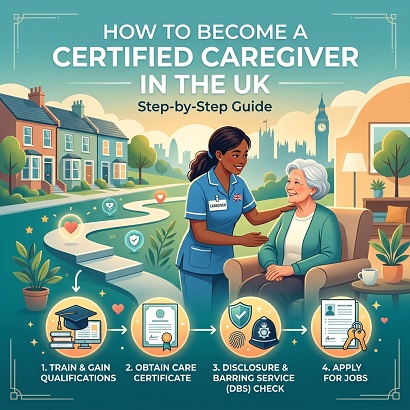
Step-by-Step: How to Become a Certified Caregiver in the UK
Step 1: Understand the Different Caregiver Roles Available to You
Before you enrol in any course, get clear on which role you're aiming for, since this affects which certification level makes sense:
- Home caregiver / domiciliary care worker — visiting clients in their own homes to assist with daily living
- Care home assistant — working within residential or nursing care facilities
- Live-in carer — providing round-the-clock support, usually for a single client
- Health care assistant (HCA) — working alongside nurses in clinical or hospital-adjacent settings
- Family/private caregiver — paid or unpaid care for a relative, sometimes formalised through direct payments
Each of these benefits from certification, but the level of training you'll want differs. A beginner certificate is often enough to start in a home-care or entry-level care home role, while more clinically involved positions benefit from a more comprehensive diploma-level qualification.
Step 2: Check the Entry Requirements
The good news: caregiving in the UK is one of the most accessible professions to enter. Generally, you do not need prior healthcare qualifications, a nursing background, or a degree. Most online caregiver certification courses require only that you:
- Are able to study in English
- Have access to a computer, tablet, or smartphone with internet access
- Are willing to commit a few hours a week to coursework
Some employers will ask for basic literacy and numeracy, a DBS (Disclosure and Barring Service) check, and references — but these are employment requirements, not barriers to starting your training. In fact, completing your certification first often makes the DBS and interview stage smoother, because you walk in already speaking the language of the profession.
Step 3: Choose Between a Certificate and a Full Diploma
This is the decision point most beginners get stuck on. Here's a simple way to think about it:
- A Certificate in Caregiving is designed for people who want to get job-ready quickly. It typically covers the essentials: healthcare systems, professional standards, communication, and core caregiving skills — enough to confidently start in an entry-level care role.
- A Diploma in Caregiving goes significantly deeper. It covers everything in the certificate, plus specialised modules such as dementia support, management of chronic health conditions, personal care protocols, safety procedures, and end-of-life care. A diploma is the better choice if you want to stand out for higher-paying roles, senior positions, or specialised care work (like dementia or palliative care), or if you're planning to use your UK-based training to work internationally later.
If you're unsure, it's worth reading how the courses differ in detail before committing — you can compare the full course list, hours, and pricing here.
Step 4: Choose an Accredited, Internationally Recognised Course Provider
This step matters more than most people realise. Not all "caregiver certificates" carry equal weight. Before enrolling anywhere, check that the provider:
- Is certified or recognised by credible bodies (for example, organisations like the American Caregiver Association, health and aged care authorities, or NHS-aligned certification standards)
- Issues a certificate employers can independently verify
- Publishes clear information about course length, module content, and pass requirements
- Offers assessments — not just video-watching — so your certificate reflects tested competency, not just attendance
MS Caregivers Academy, for example, is certified by the American Caregiver Association, the Australian Department of Health and Aged Care, and NHS England — which is why its certificates are recognised by care homes and healthcare facilities across the US, UK, Canada, and Australia, not just locally. That international recognition is exactly what you want if there's any chance your caregiving career takes you beyond one employer or one country.
Step 5: Enrol and Set a Study Rhythm
Once you've picked a course, enrolment for a reputable online caregiver certification programme usually takes minutes: create a free account, select your course, and get instant access to your learning dashboard. From there, the trick isn't finding time — it's protecting a consistent rhythm. Most working learners succeed by:
- Studying in short, focused sessions (30–45 minutes) rather than trying to binge whole modules
- Using breaks between shifts or commutes for video lessons
- Treating each module quiz as a checkpoint, not an obstacle — if you don't pass, that's useful information about what to revisit
Because self-paced online caregiver certification courses are built for people already working — not just people already studying — you're not competing with a fixed semester schedule. You move at the speed your life allows.
Step 6: Complete Your Modules and Assessments
A well-built caregiving course is broken into clear modules, each ending in a short multiple-choice assessment, followed by a comprehensive final examination covering the full course. Look for programmes that:
- Auto-grade your assessments so you get instant feedback
- Set a clear, fair pass mark (75% is standard across recognised programmes)
- Allow unlimited retakes — because the goal is genuine competency, not a single high-stakes exam
This structure matters because it mirrors how you'll actually be evaluated on the job: in small, practical checkpoints, not one make-or-break test.
Step 7: Receive Your Certificate
Once you pass your final assessment at 75% or higher, your certificate should be generated automatically — no waiting weeks for a certification body to process paperwork. A same-day, downloadable, verifiable certificate is one of the biggest practical advantages of online caregiver certification over traditional classroom routes, especially if you're trying to apply for jobs on a deadline.
Step 8: Request a Reference Letter and Start Applying
Many accredited caregiving academies also offer an optional reference letter alongside your certificate — an underrated asset for anyone with limited formal work history in care. A reference that speaks to your training, not just your character, gives hiring managers something concrete to act on.
From here, you're ready to apply. Pair your certificate with a caregiving-focused CV, target agencies and care homes that explicitly value trained candidates, and mention your certification (and its accrediting bodies) in your cover letter or application form — it's often the detail that gets you shortlisted over an equally experienced but uncertified candidate.
How Long Does It Take to Become a Certified Caregiver in the UK?
Timelines vary depending on the course level and how many hours a week you can commit:
Beginner Certificate in Caregiving ~5 hours, 3 modules 1–2 weeks
Diploma in Caregiving ~26 hours, 10 modules 4–8 weeks
Specialised courses (e.g. crisis/emergency management) ~9 hours, 6 modules 2–3 weeks
Because these courses are self-paced and available 24/7, motivated learners often move faster — some complete a beginner certificate in a single focused weekend. There's no fixed start date to wait for and no cohort to keep up with.
How Much Does Caregiver Certification Cost in the UK?
Cost is one of the most common concerns for people exploring how to become a certified caregiver, especially since many are already balancing tight budgets while between jobs or transitioning careers. Prices vary widely by provider and course depth, but online certification is almost always dramatically cheaper than in-person vocational training or a full college course, without sacrificing the credential's credibility — provided the issuing academy is properly certified.
As a rough guide, a beginner-level online certificate typically costs a fraction of what an equivalent in-person course or college diploma would charge, while a full diploma-level programme — covering far more ground, including dementia care, personal care, safety, and end-of-life support — sits at a modest premium reflecting its depth. You can see exact, transparent pricing for each course level on the course catalogue page, which is worth comparing against your target role before you commit.
Diploma in Caregiving Online vs. Beginner Certificate: Which Should You Choose?
This is worth unpacking a little further, because it's the single biggest decision new learners face.
Choose the Beginner Certificate in Caregiving if:
- You need to start applying for entry-level care jobs quickly
- You're testing whether caregiving is the right career direction for you
- You have some existing informal care experience (e.g. as a family caregiver) and mainly need a formal credential to match it
Choose the Diploma in Caregiving Online if:
- You want to be competitive for higher-paying or specialised roles from day one
- You're aiming to work with clients who have complex needs — dementia, chronic illness, or end-of-life care
- You want a credential that positions you for supervisory or senior care roles down the line
- You may eventually want to work internationally and need training that's recognised beyond a single employer or country
Many learners take the beginner certificate first to get moving quickly, then progress into the full diploma once they're working and want to formalise deeper skills — both paths are valid, and a good academy will let you build one credential on top of another over time.
What You'll Actually Learn in an Online Diploma in Caregiving
A properly built diploma in caregiving online should go well beyond generic "how to be kind to patients" content. Expect modules covering:
- Caregiving fundamentals — roles, responsibilities, and professional boundaries
- Understanding common health conditions — what carers need to recognise and how to respond
- Dementia support — communication techniques, behaviour management, and daily care strategies
- Personal care — bathing, dressing, mobility support, and maintaining dignity
- Safety and infection control — practical protocols for home and facility settings
- End-of-life care — supporting clients and families through palliative stages with compassion and competence
This is also where independent certification tends to go deeper than a single employer's induction training — because it's built to prepare you for any care setting, not just one organisation's specific procedures.
Career Opportunities and Earning Potential After Certification
Once certified, your options open up considerably. Common next steps include:
- Domiciliary (home) care roles — often the fastest entry point after certification
- Residential and nursing home positions — particularly for diploma-level graduates
- Private and live-in care — frequently better paid, especially with a dementia or specialised diploma
- Agency work — flexible scheduling, often across multiple clients or facilities
- Progression into senior carer, team leader, or care coordinator roles — typically requiring 1–2 years of experience plus additional certification
Starting salaries for UK care workers vary by region and employer type, generally rising with experience, specialisation, and additional certifications — you can check current, government-published salary bands and typical working patterns on the National Careers Service care worker page to set realistic expectations before you apply.
It's also worth noting that once you're employed, most UK care providers will still put you through the sector-standard Care Certificate induction — your independent certification doesn't replace that, but it does make you a far stronger applicant and often accelerates how quickly you're trusted with more responsibility once hired. You can find official guidance on the Care Certificate framework directly from Skills for Care, the body responsible for setting it.
7 Tips for Passing Your Caregiver Certification Exam
- Don't skip the video lessons for the slides. Assessment questions often draw from scenarios explained in the videos, not just the bullet points in the slide decks.
- Take notes module by module, even short ones — you'll use them again in the final exam.
- Treat the 75% pass mark as a floor, not a target. Aim to genuinely understand the material rather than just scraping through, since you'll be applying this in real client interactions.
- Use retakes strategically. If a programme offers unlimited retakes, use a failed attempt as a diagnostic tool — go back to the specific section the questions came from.
- Study in the context you'll work in. If you're aiming for dementia care, pay extra attention to those modules even if the exam weights them evenly with others.
- Don't rush the final examination. It typically covers the entire course, so schedule dedicated, distraction-free time for it rather than squeezing it into a five-minute gap.
- Request your reference letter as soon as you pass, while your performance and any interactions with the academy are still fresh — it's easier to get a timely reference than a retrospective one.
Common Mistakes to Avoid When Getting Certified
Talk to enough hiring managers in the care sector and you'll hear the same avoidable mistakes come up again and again. Here's what to watch for as you plan your own certification path:
Choosing a course based on price alone. The cheapest option isn't always the least credible, and the most expensive isn't always the best — but a certificate with no clear accrediting body behind it is a red flag regardless of price. Always check who is certifying the course before you check how much it costs.
Rushing through modules just to "finish." Auto-graded, self-paced courses are convenient, but the convenience is meant to fit learning into your schedule — not to encourage skimming. Hiring managers and, more importantly, the clients in your care will notice the difference between someone who passed a module and someone who actually absorbed it.
Assuming one certificate covers everything forever. Caregiving is a field with genuine continued professional development (CPD) expectations. A single beginner certificate is a strong start, but pairing it with more advanced training — dementia care, emergency response, or a full diploma — keeps you competitive as you gain experience and aim for better-paid roles.
Not asking whether the certificate is independently verifiable. Before you rely on any certificate for a job application, confirm that a prospective employer could actually verify it if asked. A downloadable PDF with no issuing body behind it carries far less weight than a certificate tied to recognised accreditation.
Ignoring the reference letter option. Many new caregivers focus entirely on the certificate and forget that a reference letter from your training provider can meaningfully strengthen a thin work history, especially for your very first paid care role.
Waiting for "the right time" to start. Because self-paced online courses have no fixed start dates, there's a temptation to keep postponing enrolment until life is less busy. In a field defined by shift work and unpredictable schedules, that "less busy" moment rarely arrives on its own — the learners who succeed are usually the ones who started before they felt fully ready.
Why International Recognition Matters, Even If You're Only Planning to Work in the UK
It's tempting to think that if you only plan to work in the UK, you don't need a certification with international recognition. In practice, this matters more than most new caregivers expect, for a few reasons:
- Care sector mobility is high. Many UK carers eventually work for agencies that also place staff internationally, or they relocate for family or personal reasons. A certificate recognised only within one small local scheme won't travel with you.
- Private clients and families often research credentials themselves. A parent or adult child hiring a private carer for a relative frequently searches the certifying body's name before an interview. Recognisable, internationally credible accreditation reassures them in a way a generic "training completed" certificate cannot.
- Larger care providers and agencies standardise around recognised credentials. As more UK care homes and domiciliary agencies expand across regions or partner internationally, they increasingly prefer staff whose training is portable and independently verifiable — not just understood by one branch office.
- It future-proofs your investment. Even if your current plan is entirely UK-based, training with an internationally certified provider means your certificate keeps its value if your circumstances change — a new city, a new country, or a new specialism within care.
This is one of the clearest reasons to be selective about where you train rather than choosing the first course that appears in a search result. A provider like MS Caregivers Academy, certified by the American Caregiver Association, the Australian Department of Health and Aged Care, and NHS England, is built specifically around this kind of portability — so the certificate you earn today keeps working for you regardless of where your caregiving career eventually takes you.
A Quick Readiness Checklist Before You Enrol
Before you commit to a course, run through this short checklist:
- [ ] I understand the difference between a beginner certificate and a full diploma
- [ ] I've confirmed the course provider's accrediting bodies
- [ ] I know the total number of hours and modules involved
- [ ] I've checked the pass mark and whether retakes are included
- [ ] I know whether a reference letter is available on completion
- [ ] I've set aside a realistic weekly study window, even if it's just a few hours
- [ ] I've compared course options and pricing on the course catalogue page
If you can tick every box, you're genuinely ready to start — not just to think about starting.
Frequently Asked Questions
Do I need a certificate to legally work as a caregiver in the UK? There's no single government-mandated licence required before you start, since care work sits within the non-regulated workforce. However, most reputable employers strongly prefer or explicitly require candidates with documented training, and you'll almost always complete the Care Certificate induction once hired regardless.
Can I become a certified caregiver online, with no classroom attendance at all? Yes. Accredited online caregiver certification courses are a fully legitimate and increasingly common route into the profession, provided the issuing academy is properly certified and your certificate is independently verifiable.
How is a diploma in caregiving different from the Care Certificate? The Care Certificate is a UK-specific, employer-administered induction framework you typically complete once you're already hired. A diploma in caregiving, like those offered by MS Caregivers Academy, is a standalone, internationally recognised credential you can earn independently, before or alongside employment, and it's often more comprehensive in scope.
Is online caregiver certification recognised by UK employers? It depends entirely on the issuing body. Certifications recognised by credible accrediting organisations are widely respected. Always check who certifies the course before enrolling.
How much does it cost to become a certified caregiver in the UK? Costs vary by course level, but online certification is generally far more affordable than in-person vocational training. Beginner certificates start at the lower end, with comprehensive diplomas priced higher to reflect their depth. Full pricing is available on the course catalogue.
What's the fastest way to become a certified caregiver? Enrol in a self-paced beginner certificate course, study consistently in short sessions, and complete your final assessment as soon as you feel ready — many learners finish in one to two weeks.
Final Thoughts: Your Path to Becoming a Certified Caregiver Starts Today
Becoming a certified caregiver in the UK in 2026 doesn't require years of study, a healthcare degree, or an expensive classroom course. What it requires is choosing a properly accredited programme, committing to consistent (not perfect) study habits, and taking the assessments seriously enough that your certificate genuinely reflects what you know.
Whether you're starting fresh, formalising experience you already have as a family caregiver, or aiming to move into more specialised or higher-paying care work, the fastest, most credible route is a structured, internationally recognised online course. You can create a free account and explore the Diploma in Caregiving and other accredited courses here — with self-paced modules, instant auto-graded assessments, and a certificate generated the moment you pass, there's very little standing between you and your first day as a certified caregiver.
Ready to get started? Visit MS Caregivers Academy to create your free account and begin your Continued Professional Development journey today.