
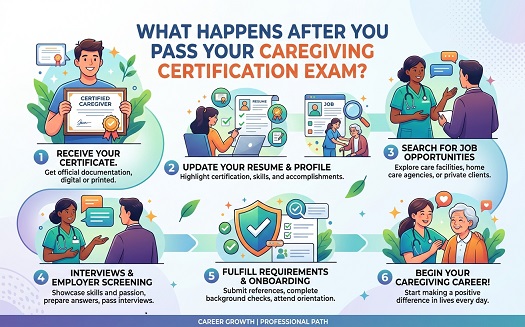
Congratulations — you've passed your caregiving certification exam. That final examination, covering everything from professional standards to hands-on personal care skills, is behind you, and you now hold a genuine, recognised credential in caregiving. But if you're wondering what actually happens next, you're asking exactly the right question at exactly the right time.
Passing your exam isn't the finish line — it's the starting gun. What you do in the days and weeks immediately following certification has a real, measurable impact on how quickly you move from "certified" to "employed and earning" in a paid caregiving role. This guide walks through exactly what happens after you pass, step by step, so you can move forward with confidence rather than uncertainty about what comes next after completing your online caregiver certification course.
Step 1: Your Certificate Is Generated — Here's What to Do With It Immediately
The moment you pass your final examination at or above the required pass mark (commonly 75% in reputable programmes), a legitimate online caregiving course should generate your certificate automatically, without weeks of waiting for a certifying body to process paperwork. This is one of the genuine advantages of online caregiver certification over some traditional routes.
Download and save your certificate in multiple places. Keep a digital copy in cloud storage, a copy on your device, and — if the option exists — a printed copy for situations where showing a physical document is more practical, such as an in-person interview.
Check that your certificate includes everything an employer would want to see. This typically includes your full name, the course title and level (certificate or diploma), the accrediting bodies behind it, the date of completion, and ideally some form of unique identifier or verification method.
Understand how an employer could verify your certificate if asked. Before you need this information in an actual job application, know whether your provider offers a verification portal, a unique certificate number, or a direct point of contact for confirming your certificate's authenticity. Being able to answer this confidently in an interview builds real credibility.
Take a moment to actually recognise this milestone. Particularly if this is your first formal qualification in a while, or if you're transitioning from an unrelated career, passing genuine assessments in professional caregiving content is a real accomplishment worth acknowledging before moving straight into job-hunting mode.
Step 2: Request a Reference Letter, If One Is Available
Many reputable training providers, including MS Caregivers Academy, offer an optional reference letter alongside your certificate. If this is available to you, request it promptly while your course completion is fresh.
Why this matters more than it might seem. A reference letter from your training provider gives hiring managers something beyond a certificate alone — a documented statement that speaks to your engagement with the course and your readiness for caregiving work. This is particularly valuable if you have limited or no prior paid work history in care specifically.
How to use it effectively. Keep this reference alongside your certificate in your application materials, and mention it specifically in cover letters or applications where you're addressing a thin formal employment history in caregiving — it directly supports the case that you're genuinely prepared, not simply certified on paper.
Step 3: Rebuild or Update Your CV Around Your New Certification
This is one of the most important, and most commonly rushed, steps in the entire post-certification process. Your CV needs to actively showcase your new credential, not simply mention it in passing.
Lead with your certification prominently. Place your caregiving certificate or diploma near the top of your CV, clearly naming the course level, the accrediting bodies behind it, and the date of completion.
Detail what your certification actually covered. Rather than simply listing the credential's name, briefly outline the specific competencies it demonstrates — professional standards, communication, safeguarding, personal care skills, and any specialised content like dementia support if you completed a diploma.
Translate any existing relevant experience clearly. If you have prior family caregiving experience, volunteering, or transferable skills from unrelated work, present these clearly alongside your new certification rather than letting them remain buried or unclear.
Follow proven CV structuring principles. The National Careers Service's guidance on CV sections recommends organising your CV around clear, standard sections — contact details, a personal statement, work experience, education and qualifications, and skills — presented in a clean, easy-to-scan format that helps a hiring manager quickly identify your relevant strengths.
Write a personal statement that connects your certification to your motivation. A brief, genuine paragraph explaining why you pursued caregiving certification and what draws you to the profession helps humanise your application beyond a simple list of credentials.
Step 4: Understand and Prepare for the Enhanced DBS Check Process
If you haven't already looked into this, now is the time to understand what's involved, since it typically becomes relevant as soon as you receive a job offer.
Know what to expect regarding timing. According to official UK government guidance on standard and enhanced DBS checks, this process usually takes around 14 days, though it can take longer if application details need correcting or if multiple police forces need to be involved in your specific check.
Understand that this is typically initiated by your employer, not you independently. Once you accept a job offer, your employer will usually begin this process on your behalf — you don't need to arrange or pay for this yourself in advance of receiving an offer.
Be aware of the DBS Adult First service. For care sector roles specifically, this service can confirm within a couple of days whether you're able to begin supervised work while your fuller enhanced check is still being processed, which can meaningfully reduce the gap between accepting a job offer and starting paid work.
Prepare your documentation in advance where possible. Having key identification documents and address history readily available can help avoid unnecessary delays once your employer initiates your check.
Step 5: Begin Your Job Search Strategically, Not Randomly
With your certificate, CV, and understanding of the DBS process in place, it's time to actually start applying — but doing this strategically produces far better results than simply submitting applications indiscriminately.
Target roles that match your certification level. If you completed a beginner certificate, focus initially on general entry-level home care or residential positions. If you completed a full Diploma in Caregiving, you're well positioned to also apply for roles involving dementia care, complex needs, or other specialised positions that a basic certificate alone wouldn't adequately prepare you for.
Research potential employers before applying. Look for care providers with genuine reputations for supporting new, certified candidates — reviews from current or former employees, information about their induction process, and any indication of how they treat newly certified staff can help you target employers more likely to be a good fit.
Apply broadly in your first few weeks, then refine based on response patterns. Casting a reasonably wide net initially helps you understand which types of roles and employers are responding positively to your specific certification and background, allowing you to focus your energy more precisely as you go.
Don't wait for the "perfect" role before applying. Many successful caregivers describe their first paid role as a stepping stone rather than a permanent destination — getting genuine paid experience, even in a role that isn't your ultimate goal, builds your CV and confidence for whatever comes next.
Step 6: Prepare Specifically for Caregiving Job Interviews
Interviews for newly certified caregivers, particularly those without extensive prior paid experience, follow some fairly predictable patterns worth preparing for directly.
Expect to be asked about your motivation for entering caregiving. Prepare a genuine, specific answer — vague responses like "I like helping people" are less compelling than a more personal, concrete explanation connected to your actual background and interests.
Be ready to discuss what your certification specifically covered. Interviewers may ask about particular scenarios — how you'd handle a confused or agitated client, or what steps you'd take if you noticed a change in someone's condition. Draw directly on what your course taught you, rather than trying to sound like you already have years of hands-on experience you don't yet have.
Prepare examples from any relevant experience, however informal. Family caregiving, volunteering, or transferable experience from unrelated work all provide legitimate material for behavioural interview questions about handling difficult situations, staying patient, or communicating effectively.
Ask thoughtful questions about induction and support. Asking about how the employer supports newly certified staff during their first weeks demonstrates genuine professional maturity and interest in doing the role well, rather than simply wanting any available job.
Be honest about being new to paid caregiving work, without being apologetic about it. Confidence in your genuine preparation — your certification, your motivation, your transferable skills — matters more than pretending to have experience you don't yet have.
Step 7: Navigate Your First Days and Weeks on the Job
Once you're hired, a new phase begins — one where your certification meets real, practical application for the first time.
Expect a structured induction period. Most employers walk new hires through their specific policies, procedures, and expectations, regardless of your certification level. This is standard practice, not an indication that your training was insufficient.
You may shadow more experienced colleagues initially. This is a valuable opportunity to observe real situations and ask questions in a low-pressure setting before managing responsibilities independently.
The employer-led Care Certificate process often runs alongside this period. In the UK specifically, many care providers formally work through the sector-standard Care Certificate induction with new staff during their first weeks, building directly on the foundation your independent certification already established.
Expect a genuine adjustment period, and don't judge yourself harshly during it. Moving from studying caregiving concepts to actually practising them with real clients involves a real learning curve, even for well-prepared, certified candidates. This is normal and expected, not a sign that your certification was inadequate.
Keep learning actively, rather than treating your certification as a finished chapter. Ask questions, seek feedback from supervisors and colleagues, and pay close attention to how experienced caregivers around you handle situations — this ongoing, informal learning complements your formal certification meaningfully during your first months.
Step 8: Think Ahead About Continued Professional Development
Passing your certification exam is a genuine milestone, but caregiving is a field built around continued learning throughout your career — worth planning for even in your first weeks of paid work.
If you started with a beginner certificate, consider your path toward a full diploma. Once you've gained some hands-on experience and settled into paid work, a Diploma in Caregiving — covering dementia support, complex condition management, and end-of-life care — can meaningfully expand the roles and specialisations available to you.
If you completed the full diploma already, think about specialised or advanced training down the line. As you gain experience and identify particular areas of interest — dementia care, palliative support, emergency response — additional specialised courses can further differentiate you for senior or specialised roles.
Keep your certificate and any related documentation organised and accessible. As your career progresses, you'll likely need to reference or provide copies of your certification repeatedly — for new employers, agency registrations, or professional development records — so establishing good organisational habits from the start saves considerable hassle later.
Stay engaged with ongoing learning even informally. Reading about developments in caregiving best practices, seeking feedback actively from supervisors, and remaining curious about the "why" behind your daily work all support your long-term growth in the field, well beyond your initial certification.
The Emotional Side of Passing: What to Expect
Beyond the practical steps, it's worth acknowledging that passing your certification exam often brings a mix of emotions that are easy to overlook amid the practical next steps.
A genuine sense of accomplishment, sometimes bigger than expected. For many learners — particularly those returning to study after years away, or balancing certification alongside full-time work or family responsibilities — passing genuine assessments in a new field is a real achievement that deserves to be recognised, not rushed past on the way to the next task.
A natural mix of excitement and uncertainty. It's entirely normal to feel both eager to start working and slightly uncertain about whether you're truly ready, even with a strong certification behind you. This combination doesn't indicate a problem with your preparation — it reflects the genuine significance of moving into new, meaningful work.
Renewed motivation that's worth acting on quickly. The energy and confidence that often follows successfully passing an exam is a real, practical asset — using it to move promptly into updating your CV and beginning your job search, rather than letting it fade through delay, genuinely helps your transition into paid work.
For those transitioning from family caregiving, a particular kind of validation. If your certification formalised years of unpaid family caregiving experience, passing your exam often carries additional emotional weight — a formal, external recognition of skills and dedication that may have gone unacknowledged for a long time. Give yourself space to recognise this, alongside the practical next steps ahead.
Building a Professional Network From Day One
Something many newly certified caregivers overlook entirely: your professional network in this field can start forming before you've even secured your first job, and it continues to matter throughout your career.
Stay connected with your training provider where possible. Some caregiving academies offer alumni communities, continued learning resources, or updates about industry developments — staying engaged with these resources keeps you connected to the field even before you've started paid work.
Connect with other caregivers, both experienced and newly certified. Online communities and forums for care workers can provide practical advice, emotional support, and sometimes even direct leads on job openings, particularly from people who understand exactly what you're navigating as a newcomer to the field.
Build relationships with any professionals from your family caregiving experience. GPs, social workers, or care coordinators who observed your family caregiving firsthand can become valuable references or even connect you directly with employment opportunities they're aware of.
Approach your first employer relationship as the start of a professional network, not just a job. Supervisors and colleagues from your first caregiving role often become valuable references and connections for future opportunities, particularly if you demonstrate genuine reliability and engagement from the outset.
Consider joining relevant professional or sector groups as you progress. As your caregiving career develops, connecting with broader professional networks in the care sector can support your access to specialised training, career progression opportunities, and industry knowledge beyond what any single employer provides.
Common Mistakes People Make Right After Certification
Understanding these common missteps can help you avoid losing momentum immediately after passing your exam.
Waiting too long before updating their CV and applying. The motivation and momentum immediately following certification is valuable — delaying your job search significantly can mean losing some of that natural energy and confidence.
Treating the certificate as self-explanatory on a CV. Simply listing a course title without context about what it covered or why it matters leaves hiring managers to guess at your actual readiness, rather than clearly demonstrating it.
Applying only to a narrow set of highly specific roles. Particularly for newly certified candidates without extensive prior experience, casting a reasonably wide net in early applications tends to produce faster, more useful results than holding out exclusively for one ideal position.
Underestimating the value of a reference letter. Skipping this step, when it's available from your training provider, means missing an easy opportunity to strengthen your application materials at essentially no additional cost or effort.
Not preparing for the DBS check timeline. Being caught off guard by a two-week (or occasionally longer) background check process can create unnecessary stress — understanding this timeline in advance helps you plan your expectations around when you might realistically start working.
Losing confidence during the job search if early applications don't succeed. It's common for even well-prepared, certified candidates to face some early rejections or silence — this reflects the realities of job searching generally, not necessarily a flaw in your certification or preparation.
Setting Goals for Your First Six Months as a Certified Caregiver
Having a rough plan for the months following certification, beyond simply "get a job," helps you approach this transition with intention rather than reacting to whatever comes.
Month one: secure your first paid role. Focus your energy on completing the practical steps covered throughout this guide — CV, applications, interviews, and DBS processing — with the specific goal of starting paid work as promptly as your circumstances allow.
Months two and three: focus on building genuine competence and confidence. Rather than worrying about long-term career progression immediately, prioritise learning as much as possible from your day-to-day work, asking questions, and absorbing feedback from supervisors and experienced colleagues.
Months four and five: start reflecting on what you enjoy and where you might specialise. As you gain real hands-on experience, you'll likely notice particular aspects of caregiving that genuinely interest you — dementia care, a specific client population, or a particular type of care setting — worth paying attention to as you think about your longer-term direction.
Month six: consider your next formal training step. If you started with a beginner certificate, this is often a natural point to evaluate whether progressing to a full Diploma in Caregiving makes sense, based on both your growing interest in the field and any specific gaps you've noticed in your knowledge through real practice.
Having this rough framework doesn't mean rigidly following a fixed schedule — everyone's path looks somewhat different — but it does provide a useful sense of direction during a period that can otherwise feel like an unstructured, open-ended transition.
A Realistic Timeline From Passing Your Exam to Your First Paid Shift
Bringing all of these steps together, here's a realistic overall picture of what the weeks immediately following certification often look like:
Days 1–3: Receive and organise your certificate, request a reference letter if available, and begin updating your CV.
Days 4–10: Finalise your CV and begin actively applying to relevant roles, researching potential employers, and preparing for interviews.
Weeks 2–4: Attend interviews, receive job offers, and begin the Enhanced DBS check process once an offer is accepted.
Weeks 3–6: Complete your DBS check (or begin supervised work sooner via DBS Adult First where applicable), complete employer induction, and begin your first paid shifts.
Individual timelines vary considerably based on local job market conditions, how quickly you move through each step, and factors outside your direct control like DBS processing times — but this general sequence gives you a realistic sense of what typically unfolds in the weeks following successful certification.
Frequently Asked Questions
How quickly will I receive my certificate after passing my exam? With a properly built online caregiver certification course, your certificate should be generated automatically and immediately upon passing, rather than requiring a lengthy processing period.
Do I need work experience before I can apply for caregiving jobs after certification? No. Many employers hire newly certified candidates without prior paid caregiving experience, particularly for entry-level roles, provided your certification is from a recognised, accredited provider.
What should I do if I don't hear back from job applications right away? Continue applying broadly rather than waiting for a single specific role, and consider reviewing your CV against established guidance, such as the National Careers Service's CV advice, to ensure your certification and relevant experience are presented as clearly as possible.
How long does the DBS check take once I accept a job offer? According to official UK government guidance, standard and enhanced DBS checks typically take around 14 days, though this can vary depending on individual circumstances and whether multiple police forces need to be involved.
Should I start job hunting immediately after passing, or wait until I feel fully confident? Start soon after passing. Momentum and confidence tend to be highest immediately following certification, and much of the remaining "confidence building" naturally happens through the process of applying, interviewing, and eventually working — not by waiting indefinitely beforehand.
What if I passed a beginner certificate but now want to pursue more specialised roles? Consider building toward a full Diploma in Caregiving once you've gained some initial paid experience, since this expands the specialised and higher-responsibility roles available to you.
Is it normal to feel nervous about starting my first paid caregiving role despite being certified? Completely normal. Certification provides a genuine, tested foundation, but real confidence in practical application builds through actual hands-on experience — this is an expected part of the transition, not a sign that your certification was insufficient.
Final Thoughts: Certification Is the Foundation, Not the Finish Line
Passing your caregiving certification exam is a genuine, meaningful accomplishment — but what happens in the days and weeks that follow determines how quickly that accomplishment translates into an actual paid role and a real caregiving career. By promptly securing your certificate and any available reference, rebuilding your CV around your new credential, understanding the DBS process, and applying strategically, you turn your certification from a static achievement into active career momentum.
If you haven't yet completed your certification, or if you're ready to build further with a full diploma, you can create a free account and explore the Certificate and Diploma in Caregiving courses here — designed to prepare you not just to pass an exam, but to move confidently into paid, meaningful caregiving work afterward.
Ready to take the next step in your caregiving journey? Visit MS Caregivers Academy to continue your Continued Professional Development today.